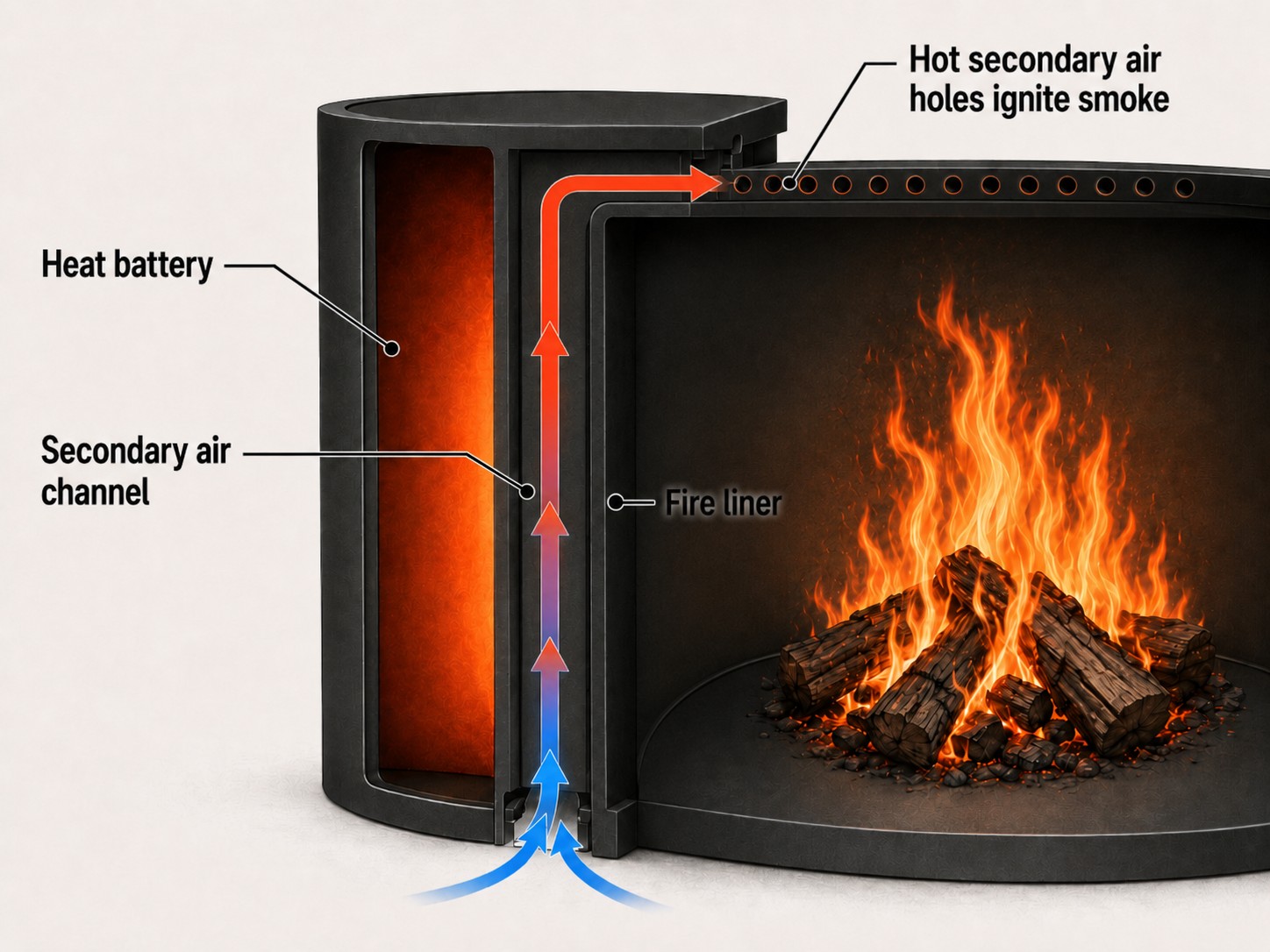
Every smokeless fire pit on the market uses secondary combustion. The principle is the same across all of them: draw air in at the bottom, heat it as it travels up through a channel in the wall, inject it near the top of the fire chamber where it reignites the smoke before it escapes.
So if they all do the same thing, why does the Ferno perform differently?
The answer is the heat battery — and it changes everything about how the unit behaves over the course of a real fire evening.
What secondary combustion actually does
When wood burns, it doesn't burn completely in one step. The initial combustion produces heat, light — and a large amount of partially burned gas and carbon particles that we see as smoke. In an open fire, this smoke simply escapes into the air and onto your jacket.
Secondary combustion intercepts this smoke before it escapes. Hot air is injected at the top of the fire chamber and reignites those unburned particles. What you normally see as smoke becomes fuel — burned cleanly, producing more heat and less waste.
The result is a cleaner burn, more heat from the same wood, and dramatically less smoke.
What you normally see as smoke becomes fuel. The secondary combustion process burns it before it reaches your nose, your eyes, or your jacket.
The problem every smokeless fire pit has — except the Ferno
Secondary combustion only works when the secondary air is hot enough to reignite smoke. That means it needs the fire to already be burning well before it kicks in — and it stops working effectively when the fire drops below a certain temperature.
A real fire evening doesn't burn at a constant temperature. It has cycles:
In a standard thin-wall smokeless fire pit, the unit follows the fire temperature exactly. When the fire drops, the secondary air cools immediately. Smoke returns. You smell it. Then when the fire picks back up, the secondary combustion kicks in again — but there's a lag while the unit heats back up.
This is the dirty secret of most smokeless fire pits. They work beautifully at peak burn. They struggle at every other point in the fire cycle.
What the heat battery changes
The Ferno's walls are filled with sand — a dense thermal mass that absorbs heat during the peak burn and releases it slowly over time. This is the heat battery.
The sand doesn't just sit there doing nothing. It stores the heat energy from the peak burn and keeps the secondary air channel warm long after the visible flame has dropped. When you add a new log, or when the fire naturally cycles down between burns, the secondary air is still being preheated by the stored heat in the walls — not just by the current flame temperature.
The secondary air stays hot even when the fire doesn't.
In a standard unit, secondary combustion stops working the moment the fire temperature drops. In the Ferno, the heat battery keeps the secondary air channel warm through the natural cycles of the fire — so you get cleaner combustion across the entire evening, not just during peak burn.
How the system works — step by step
Looking at the cross-section diagram at the top of this article:
- Cool air enters at the base — drawn in by the natural convection of the fire above
- It travels up through the secondary air channel — the gap between the fire liner and the outer wall, surrounded by the heat battery
- The sand heats the air as it rises — by the time it reaches the top, the air is significantly hotter than when it entered
- Hot air is injected through the ports at the top of the chamber — the row of holes visible around the inside rim of the Ferno
- This hot air ignites the smoke — the unburned particles combust, producing more heat and less smoke
The fire liner separates this process from the main fire chamber, allowing the secondary air to heat independently of the flame directly below it.
Why South African conditions make this more important
South African fire evenings are long. People sit outside for three, four, five hours. A fire that smokes heavily every time it cycles down is not a fire pit — it's a chair-moving exercise that happens every 20 minutes.
The heat battery means the Ferno maintains secondary combustion performance across a long evening, not just for the first hour when the unit is at peak temperature. Add a log, drop your fire, let it breathe — the secondary air stays hot enough to keep doing its job.
Thin wall, no thermal mass
Follows fire temperature exactly. Secondary combustion works at peak burn, struggles during die-down and after new logs are added. Performance is inconsistent across the evening.
Sand-fill thermal mass
Stores heat at peak burn, releases it slowly through the evening. Secondary air stays hot through natural fire cycles. Cleaner, more consistent combustion from start to finish.
The ash drawer discovery
During the installation at Soetdoring Restaurant in June 2026, an ash drawer was fitted to the Ferno. What was discovered changed how we think about primary air preheating.
The ash drawer sits below the fire chamber and gets hot during burning. As it heats up, it preheats the primary air entering at the base of the unit before it even reaches the secondary air channel. The result is a more intense, more spectacular flame set — preheated primary air feeding a fire that's already receiving preheated secondary air from above.
Two-stage air preheating. The heat battery working in both directions.
The Ferno is not the cheapest smokeless fire pit available. It is not the lightest or the smallest. It is the one that keeps working when your fire does what fires naturally do — cycle, breathe, rise, and fall — across a full South African outdoor evening.
That is what the heat battery is for.