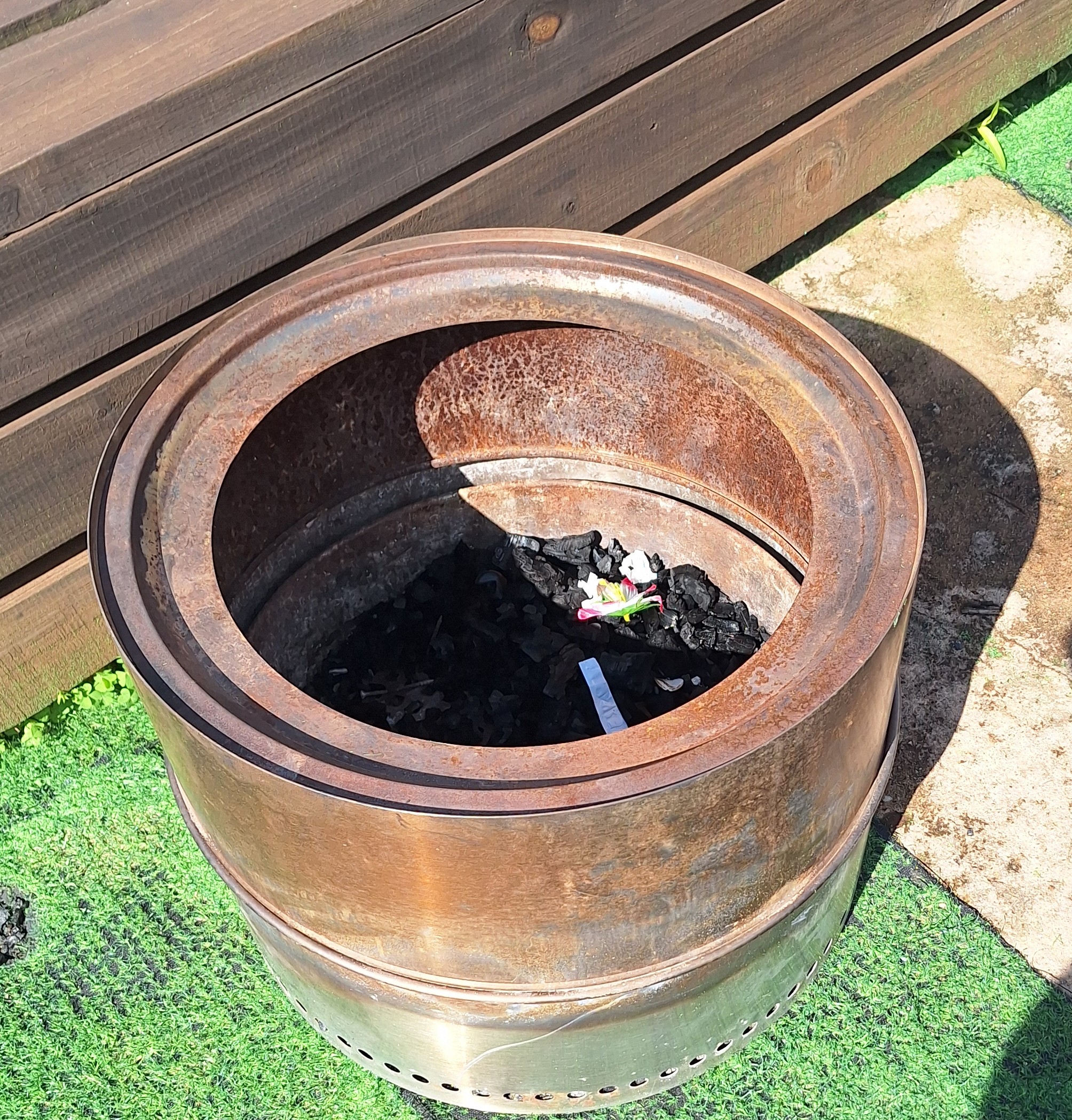
That photograph was not taken after years of neglect. That is what happens to a stainless steel fire pit after normal use.
The golden-brown patina, the rust spots where the surface has broken down, the ash-stained interior — this is heat doing exactly what heat does to stainless steel at fire temperatures. This is a normal, used fire pit. This is expected.
Stainless steel is a brilliant material. It is the right choice for kitchen sinks, surgical instruments, food processing equipment, marine fittings, and exhaust systems. In those applications it performs exactly as advertised — corrosion resistant, hygienic, durable, attractive.
But a fire pit is not a kitchen sink. And what fire does to stainless steel is a story most manufacturers would prefer you did not know before you bought one.
What stainless steel actually is
Stainless steel is mild steel with chromium added — typically 10–11% or more. The chromium reacts with oxygen in the air to form a thin, invisible chromium oxide layer on the surface. This passive layer is what makes stainless steel corrosion resistant. It self-repairs when scratched, as long as the conditions allow the chromium oxide to reform.
It is elegant chemistry. But it has a temperature problem.
What heat does to stainless steel
The chromium oxide passive layer that makes stainless steel corrosion resistant begins to break down at sustained temperatures above approximately 400–500°C. At the temperatures found in a working fire pit — particularly in the direct flame zone and around the secondary combustion ports — this is not a threshold that is occasionally approached. It is regularly exceeded.
The chromium migrates
Between 425–850°C, chromium carbides form at the grain boundaries of the steel. Chromium is drawn away from the surface, depleting the passive layer exactly where corrosion resistance is most needed. The steel becomes vulnerable to rust in the heat-affected zones.
The colour change is permanent
The gold, brown, purple, blue and grey colours visible on a used stainless fire pit are iron oxide and chromium oxide forming at different thicknesses on the surface. This is not cosmetic. It indicates the passive layer has been altered. The discolouration cannot be fully reversed.
Expansion and contraction damage
Stainless steel has a higher thermal expansion coefficient than mild steel. Repeated heating and cooling cycles cause thin stainless sheet to expand, contract, warp, and eventually crack at welds and joints. Thin-gauge stainless is particularly vulnerable because there is less material to absorb the stress.
The passive layer that makes stainless steel corrosion resistant is destroyed by the same temperatures that make a fire pit work. You cannot have both.
The thickness problem
Most stainless fire pits sold online use thin-gauge sheet — typically 0.6 to 1.0 mm. This is not a cost-cutting decision made by careless manufacturers. It is a material reality.
Stainless steel is significantly more expensive than mild steel by weight. To keep costs competitive, manufacturers use thinner sheet. But thin sheet combined with high heat creates compounding problems:
- Less thermal mass means the unit heats and cools rapidly — increasing the frequency and severity of thermal cycling damage
- Thinner walls have less structural integrity — warping is more likely and more severe
- Less material at welds means heat-affected zones are proportionally larger relative to the total structure
- Grid support is weaker — a thin stainless grid that looks robust in a product photo may flex under a potjie after repeated firing
Sheet stiffness changes with the cube of thickness. A 1.6 mm sheet is not 2.7 times stiffer than a 0.6 mm sheet — it is approximately 19 times stiffer. That is the difference between mild steel and thin stainless in structural terms. Not a small margin. Not a rounding error. Nineteen times.
Why mild steel is the right choice for a fire pit
Mild steel does not have the corrosion resistance of stainless steel. Left outside in the rain without treatment, it will rust. This is a known property and it is managed — through design, coating, and use.
But mild steel has properties that make it genuinely better suited to fire pit application:
- It does not sensitise at fire temperatures — mild steel does not have the chromium grain boundary problem that destroys stainless corrosion resistance under heat
- It has lower thermal expansion — it moves less during heating and cooling cycles, reducing warping and weld stress
- It is available in greater thickness at lower cost — the Ferno uses 1.6 mm mild steel throughout. The same wall thickness in stainless would cost significantly more and provide no meaningful benefit at fire temperatures
- It develops a stable surface oxide under heat — the dark, matte finish of a used mild steel fire pit is stable iron oxide. It is not corrosion. It is protection.
The cost comparison
| Factor | Thin stainless (0.6–1.0mm) | Mild steel 1.6mm (Ferno) |
|---|---|---|
| Material cost per kg | Higher | Lower |
| Thickness achievable at price point | 0.6–1.0 mm | 1.6 mm |
| Structural stiffness | Baseline | Up to 19× stiffer |
| Corrosion resistance (ambient) | Excellent | Good with care |
| Corrosion resistance (at fire temp) | Passive layer destroyed above ~500°C | Stable iron oxide forms |
| Thermal cycling durability | Warps, cracks at welds | Lower expansion, more stable |
| Appearance after real use | Gold, brown, rust spots | Dark, stable, even patina |
| Grid load capacity | Kettle and light pans | Potjie, pans, serious cooking |
Where stainless steel belongs
None of this is an argument against stainless steel. It is an argument for using the right material in the right application.
Stainless steel is genuinely the right choice where ambient corrosion resistance matters most — marine environments, food contact surfaces, medical equipment, coastal outdoor furniture. In those applications, the passive layer stays intact because temperatures stay low. The material performs exactly as its chemistry promises.
A fire pit operates at 400–800°C in regular use. At those temperatures, the passive layer that makes stainless steel valuable is the first casualty. What remains is an expensive, thin sheet of steel that has lost its primary advantage.
The photograph at the top of this article is not a warning about a bad product. It is a photograph of stainless steel doing exactly what stainless steel does when you put real fire through it.
The Ferno is built from 1.6 mm mild steel because that is what the application requires — not what looks best in a product photograph.