I recently sent the Phala rocket stove to a family member to get honest feedback from a group of campers. Around 10 campers had a look, used it, and gave feedback.
That is exactly the type of testing I wanted: not polished product photography, not showroom opinions — real campers, real fire, real handling.
Everything went well.
Until the inevitable happened.
Every camping group has one: the bright spark with a degree in Campfire Science from the University of Folding Chairs, usually standing with one hand on a cooler box and the other hand pointing at something he has never built.
This one announced:
"But you can get one for half the price on Temu… and it is stainless steel."
Beautiful.
That is the exact moment the fire gets quiet, the wors stops turning, and the engineering department arrives wearing slops.
Opinions are like backsides — everybody has one. Around a campfire, some people just feel the need to put theirs on display.
So let's have a look at the difference between a shiny stainless advert and a 5 kg, 1.6 mm steel stove built to actually work after the first fire.
Let's talk numbers
So Phala is roughly 8 times heavier. Not slightly heavier. Not "a bit more solid." Eight times.
And steel stiffness changes roughly with thickness³. So:
1.6 ÷ 0.6 = 2.67 → 2.67³ = ±19
That means a 1.6 mm strip is roughly 19 times stiffer than a 0.6 mm strip of similar shape.
This is not mild steel versus stainless steel. This is real steel thickness versus shiny thin sheet metal. That is not a fair fight. That is a beer can arguing with a braai grid.
"But stainless steel does not rust"
Correct. And a plastic chair does not rust either. That does not mean I want to put a potjie on it.
Stainless has one brilliant marketing advantage: it looks shiny in the advert.
But once you actually put fire through it — especially proper rocket stove heat — that pretty shine changes very quickly.
Rocket stove heat is not candlelight. Top cooking areas can easily see around 300–500°C, and direct flame-contact zones can go higher depending on airflow and fuel.
At those temperatures, stainless can:
- Turn gold, brown, purple, blue, or grey
- Lose the showroom shine permanently
- Expand and move
- Warp if it is thin
- Become harder to pack flat after repeated heat cycles
So yes, the cheap one may be stainless. It will still look like it survived a small war after real use.
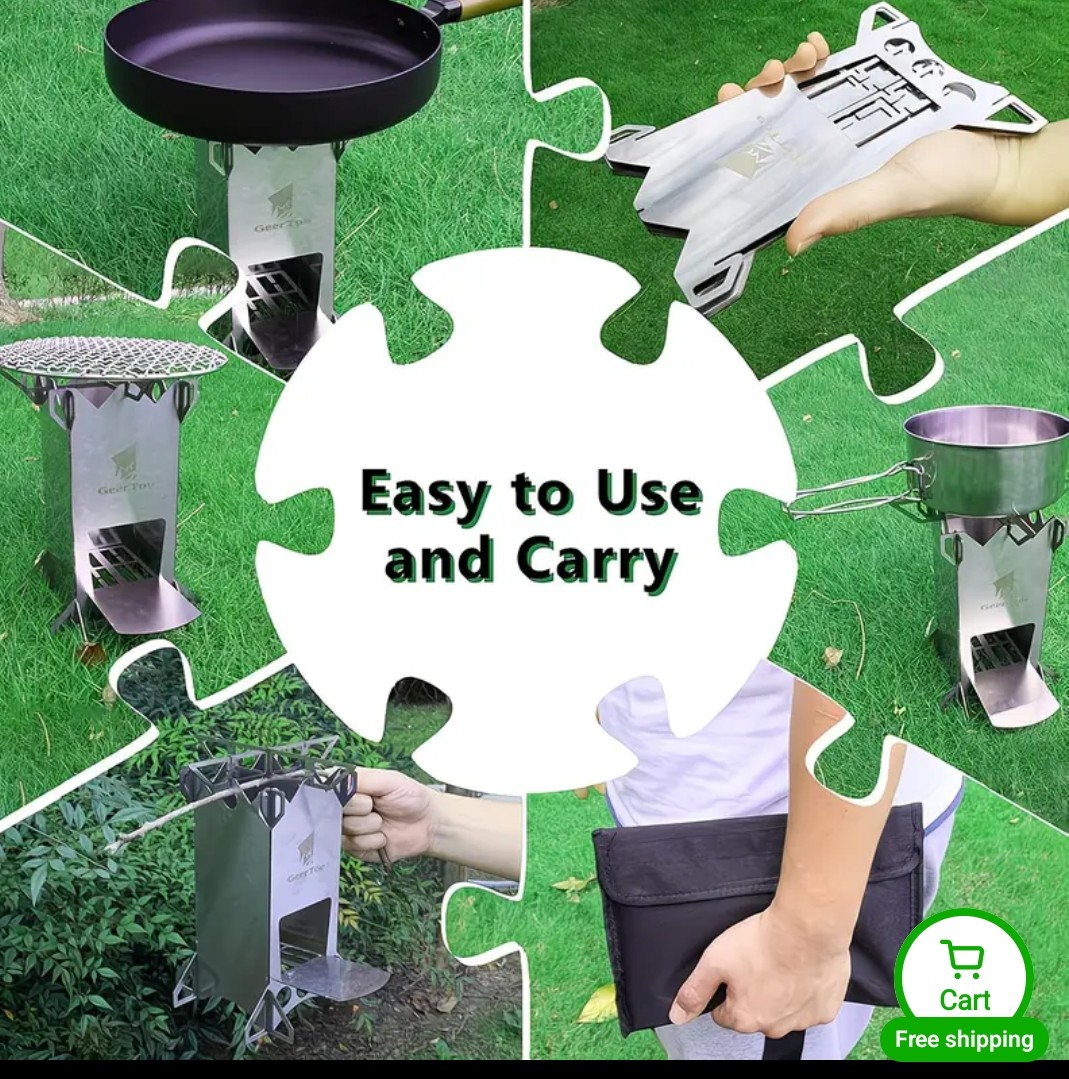
Grid stability: where the nonsense stops
A stove is not only there to hold a kettle for the product photo. It must hold real cooking loads.
The Phala top uses a 1.6 mm double-cross support layout. Many lightweight stainless folding stoves use much thinner sheet and simpler support geometry.
- Thin stainless single-cross grid: Nice for a kettle. Maybe a small pan. Maybe a noodle emergency.
- Phala 1.6 mm double-cross grid: Built for proper camp cooking, bread, pans, and repeated use.
There is a difference between "can hold something once" and "will still hold it after being used by campers who believe firewood is a personality test."
Weight is not always the enemy
For backpack hikers, 0.6 kg is attractive. No argument. But Phala is not trying to be a little emergency stove hidden between wet wipes and a headlamp.
Phala is a proper camp cooking unit. The weight is part of the job:
- More stable on the ground
- Less likely to tip
- Better heat mass
- Less warping
- Stronger grid
- Better support for pots
- More durable after repeated fires
A 5 kg rocket stove is not a mistake. It is steel doing steel things.
Draft and heat also matter
A rocket stove is not just four shiny panels and a bag. Stack height affects draw. A 400 mm stack creates roughly double the natural draft of a 200 mm stack.
A taller hot stack generally means:
- Easier start-up
- Stronger pull
- Cleaner burn
- Less smoke puffing back
- Better recovery when cold wood is added
That is why stove geometry matters — and why a flat pack of shiny panels is not automatically a rocket stove just because someone called it one.
The verdict
| Factor | Temu-style stainless | Phala |
|---|---|---|
| Weight | 0.6 kg — lighter | 5 kg |
| Price | Cheaper | R1,730 |
| Steel thickness | ~0.6 mm | 1.6 mm — 19× stiffer |
| Heat resistance | Warps, discolours | Built for it |
| Grid stability | Single-cross, thin | Double-cross, 1.6 mm |
| Pot support | Kettle / small pan | Potjie, pans, bread |
| Durability | First fire = showroom shine gone | Repeated real use |
| Draft / stack | Short, weak draw | Taller, stronger pull |
So what is Phala actually competing against? Not the cheapest shiny thing online. Phala competes against the problem campers actually have: cooking properly on fire without dragging half a braai setup along.
The cheap stainless unit has its place. It is light. It is shiny. It is affordable. It looks great before the first fire.
Yes, you can buy a toy hammer. Just don't compare it to the one you use to build something.
And yes, Temu also sells earplugs — handy for when the campfire engineer starts comparing a 600 gram shiny folder to a 5 kg steel stove.